
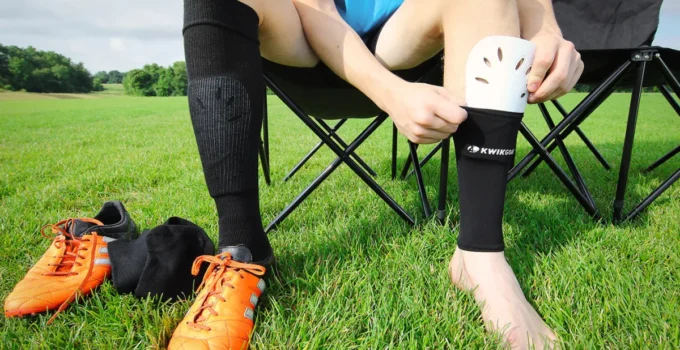
A shin guard that slips down after every sprint can ruin a football match. You stop to pull it back into position, tighten your socks and hope it stays there until the final whistle.
Buying a smaller pair might seem like the obvious solution. However, guards that are too small leave more of your shin exposed, and oversized ones can restrict movement or press uncomfortably against your ankle.
The right shin guards should cover a substantial portion of your shin, follow the shape of your leg and remain in position when you run, turn and tackle. Finding that combination depends on size, shape, padding and the way you secure them.
How Should Football Shin Guards Fit?

Start by identifying the area you need to protect. Your shin is the front of your lower leg, between the knee and ankle.
The guard should sit comfortably along that area without touching the kneecap or pressing into the ankle joint.
A useful starting point is to position the top edge around two finger widths below the kneecap, leaving enough clearance above the ankle for normal movement. The exact coverage depends on your leg length and the guard design.
The current Laws of the Game require shin guards to be made of suitable material, provide reasonable protection and remain covered by socks.
The rules do not establish a universal minimum length. Players are responsible for choosing appropriate protection.
A tiny guard covering only a small section of the leg may be comfortable, but it leaves considerably more skin and bone exposed during tackles.
Measure Your Lower Leg Before Choosing a Size
Football boot size is not a reliable way to choose shin guards. Two players wearing identical boots can have very different lower leg lengths.
Measure the distance between the area just below your kneecap and the top of your ankle. Compare that measurement with the size chart supplied for the guards you are considering.
Most manufacturers provide sizing recommendations based on height or guard length, although the measurements are not identical across different products.
For example, one medium guard might measure 15 cm long, and another could measure 18 cm. The letter on the packaging tells you very little without the actual dimensions.
Also consider the width of your shin. A narrow guard may sit awkwardly on a wider leg, even if its length is correct.
Slip-In, Ankle Protection or Compression Sleeve Guards?
Football shin guards come in several designs. The main differences concern coverage, how they attach to the leg and how much movement they allow.
Slip-in guards are popular among players who dislike bulky equipment. They sit beneath the football socks and usually rely on sleeves or other retainers to remain secure.
Models with ankle protection extend coverage toward the lower leg. Some include padded ankle sections and straps that pass beneath the foot.
Try different designs rather than assuming the smallest guard will be the most comfortable.
Test the Fit Before Wearing Them in a Match
Standing still in a sports shop tells you very little about how shin guards will behave during football.
Once you have positioned the guards and pulled up your socks, perform a short movement test.
- Walk normally. Check for pressure against the ankle or knee.
- Jog for 20 to 30 seconds. Notice if either guard moves downward.
- Perform several quick turns. The guards should remain centered on your shins.
- Squat and raise your knees. Check that the upper edges do not dig into the skin.
- Make several kicking movements. Your socks and guards should remain secure without restricting your legs.
If a guard slides several centimeters during a short jog, it will probably become more frustrating during a full match.
Check the size and retaining system before trying to solve the problem with additional tape.
How to Stop Shin Guards Sliding Down
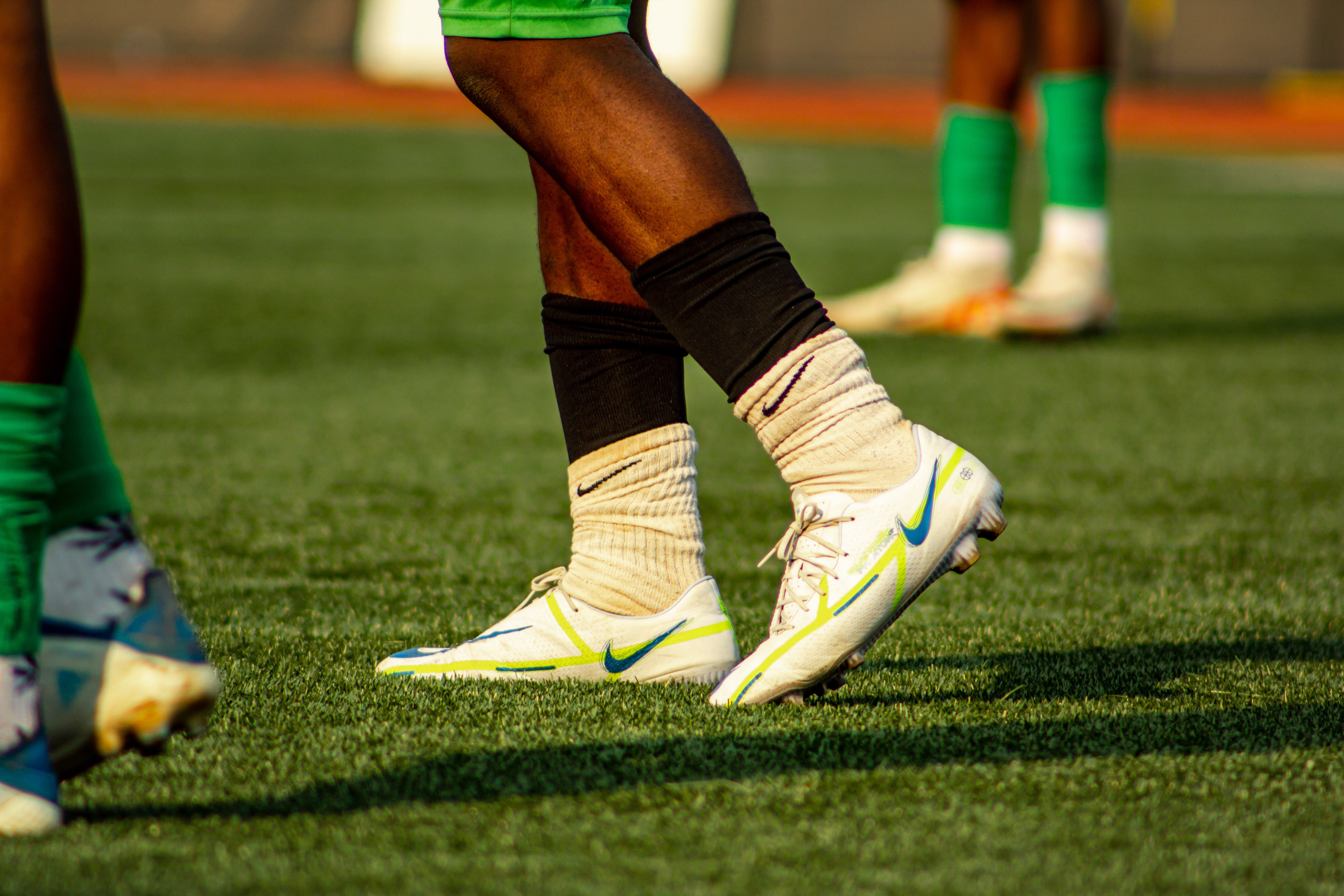
Constantly adjusting shin guards is annoying, especially during matches involving frequent sprints and sudden changes of direction.
The problem usually comes down to the guard shape, the fit of the retaining system or socks that no longer hold the equipment securely.
Use Compression Sleeves
A fitted compression sleeve holds the guard against the leg and helps prevent movement.
Choose a sleeve that feels secure without causing discomfort or leaving deep pressure marks.
If the sleeve repeatedly slides down, it may be too loose or may have lost its elasticity.
Check Your Football Socks
Loose socks provide little support for slip-in guards.
Choose football socks that fit your calf properly and can cover the guards completely.
Some players use separate grip sleeves beneath their match socks, particularly when they prefer short guards.
Use Suitable Football Sock Tape
Football sock tape can help secure the area around the guard.
Place it around the sock at the appropriate position without tightening it enough to cause discomfort or restrict circulation.
Under the current football rules, tape or other material applied externally must match the color of the sock section it covers.
Remember that tape is an additional retaining method. It cannot correct a guard that is fundamentally the wrong size or shape.
Hard Shell and Padding Both Affect Comfort
Most conventional shin guards combine a harder outer shell with softer material facing the leg.
The outer shell helps spread impact forces across a larger area. Padding improves comfort and can contribute to impact absorption.
A curved guard that follows the shin usually feels more natural than a rigid shell pressing against two narrow points.
Check the inner padding before purchasing. Areas that feel uncomfortable during a short fitting may become more irritating after repeated running and sweating.
Also inspect the edges. Rough or poorly finished plastic can rub against the skin, particularly when a guard moves inside the sock.
Can Custom-Shaped Shin Guards Improve the Fit?
Players have different calf widths, shin lengths and leg contours. Standard guards are manufactured to fit groups of people rather than every individual leg shape.
Custom designs offer another approach.
Research published in Virtual and Physical Prototyping investigated 3D printed composite shin guards using digital leg measurements and mechanical testing.
The researchers studied how material composition and guard design affected strength and impact performance. Their findings demonstrated the potential of custom manufacturing, although successful laboratory results do not mean every printed guard provides adequate protection.
Designers exploring individualized shapes can use Prusa 3D Printers to produce fitting prototypes and assess the shape before developing a finished protective product.
For actual match protection, impact performance is essential. The NOCSAE shin guard standard establishes performance requirements for manufactured football shin guards.
A homemade prototype should never be treated as proven protective equipment without appropriate testing.
Common Shin Guard Mistakes That Players Make
Many fitting problems begin with choosing equipment based on appearance rather than coverage or movement.
Buying the Smallest Size Available
Extremely small guards may feel less noticeable during play, but they protect a smaller area of the lower leg.
Choose a size that offers reasonable coverage and still allows normal movement.
Wearing Guards Too Low
Positioning guards close to the ankle can leave the middle and upper shin poorly covered.
Center the protection over the shin instead of allowing the guard to settle near the top of the boot.
Using Worn-Out Compression Sleeves
A sleeve that has stretched after months of use may stop holding the guard securely.
Replacing the sleeve can solve the problem without requiring new guards.
Ignoring Cracks in the Outer Shell
A cracked or badly deformed guard may no longer distribute impact forces as intended.
Replace damaged protective equipment rather than covering the crack with tape.
When Should You Replace Your Football Shin Guards?

There is no universal replacement schedule because durability depends on the materials, usage and impacts received.
Inspect your guards regularly, particularly after a heavy tackle.
Cracks, damaged padding, broken attachments and permanent deformation are clear reasons to replace them.
Young players also need new sizes as they grow. A pair that fitted properly at the beginning of the season may provide insufficient coverage several months later.
For adults, a change in guard position or repeated slipping can indicate that the retaining sleeve needs attention.
The Final Check Before Kickoff
Put on your football boots, guards and match socks exactly as you intend to wear them during the game.
Run a few meters, change direction and bend your knees. The guards should remain centered, cover a reasonable portion of the shin and feel secure without excessive pressure.
If you need to stop every few minutes to pull them back into place, the fit still needs adjustment.
A properly selected pair should let you concentrate on the next pass, tackle or shot instead of spending the match fixing your socks.
